

How 19.22 Crore Steps Made Life Insurance Part of Everyday Life
Case Study - Aviva Smart Vitals and the making of #LetsChaloIndia
How 19.22 Crore Steps Made Life Insurance Part of Everyday Life
Case Study - Aviva Smart Vitals and the making of #LetsChaloIndia


Client
Aviva Life Insurance India
Campaign
Aviva Smart Vitals | #LetsChaloIndia
Campaign Period
January to March 2026
Agency Contribution
Campaign strategy, creative platform, integrated communication and activation ecosystem
Recognition
Award-winning integrated campaign
The result that makes you stop
India walked approximately 19.22 crore steps as part of the Aviva Smart Vitals campaign.
That number makes a strong headline. But it matters for a deeper reason. It shows that a life insurance campaign moved beyond being watched. People acted on it. They took an ordinary behaviour that already belonged to their day and connected it with a stronger form of protection.
The campaign delivered 5.96 million media impressions, reached 1.73 million people, generated 4.58 million video views and recorded 1,00,112 engagements. The two launch films alone drew 3.15 million views. Across owned social media, the engagement rate reached 3.98%, while Instagram recorded a 14% engagement rate.
Those outcomes did not begin with a media format. They began with one uncomfortable category question.

The category problem
Life insurance has always carried an important promise: protection for the future. Yet the promise often feels distant from the life a customer is living now.
The category frequently asks people to think about risk, uncertainty and loss. These are necessary conversations, but they are rarely welcome ones. Consumers understand the importance of protection, yet they often postpone the purchase or disengage once the policy is bought. The product remains important, but the relationship becomes invisible.
For a modern consumer, that distance creates a relevance problem. Daily life now contains constant feedback. A payment app confirms a transaction immediately. A delivery app shows progress in real time. A fitness tracker counts every step. People have become used to products that respond, update and help them act. Traditional life insurance, by comparison, can feel silent between purchase and claim.
Our brief, therefore, was larger than creating awareness for a product. We had to find a credible role for life insurance in the present tense.

The Indian context
India cannot be addressed as one uniform audience. Routines change by city, age, profession, family structure and access to time. Yet one behaviour travels remarkably well across these differences: walking.
A walk can be part of a commute, a school drop, an office break, an evening in the society compound or a deliberate fitness routine. It does not need a specialised setting. It fits into the gaps of a busy day. For a time-poor audience, that matters.
The modern Indian target audience we were speaking to was responsibility-rich. They were building careers, managing homes, supporting parents, raising children and making a growing number of health decisions. Many already encountered step counts through a phone or a wearable. But health goals often remained personal and easy to postpone, while protection remained a family responsibility and easy to defer.
We saw an opportunity to bring those two unfinished intentions together.

The product truth
Aviva Smart Vitals gave the campaign a powerful and credible foundation. Eligible customers who consistently achieved the required fitness goals could unlock up to two times the life cover without paying an additional premium, subject to the product terms and conditions.
This changed the communication task completely. We did not have to manufacture a motivational layer around the policy. The product itself created a meaningful exchange: healthier behaviour could contribute to stronger protection.
That link gave us what every strong campaign needs. A simple truth that could be understood quickly, experienced personally and repeated consistently across formats.

The strategic shift
The category convention was to begin with the possibility of something going wrong. We chose to begin with a person doing something right.
Our strategic thought was clear: every step towards better health is a step towards better protection.
This shifted the role of Aviva from a company that waits at the end of a policy journey to a partner that can encourage progress throughout it. It also shifted the emotional tone. Instead of fear, we used forward movement. Instead of a distant promise, we offered visible progress. Instead of asking people to dwell on mortality, we gave them a reason to participate in life.
The Idea
We built #LetsChaloIndia as a national invitation to move.
The phrase worked at two levels. Chalo is one of the simplest calls to action in everyday Indian speech. It can mean let us go, let us begin, let us move. It feels collective without sounding institutional. Adding India gave the behaviour a shared scale. A personal walk could become part of national progress.
The campaign invited people to walk 10,000 steps. The number gave the action a clear daily target. The product gave the action meaning. People were not walking for a badge or a temporary leaderboard alone. They were walking towards healthier living and the possibility of stronger life protection.
The creative system carried one central message across every touchpoint: live healthier, live longer, live protected.

Why the idea could travel nationally
A national idea needs scale, but it first needs familiarity. Walking gave us both.
The action was easy to understand. It could begin immediately. It did not ask the audience to learn a new ritual before entering the campaign. The step count created a common unit of progress, while the phone or wearable made that progress visible. The health benefit felt personal. The protection benefit connected it back to the family.
This combination helped the campaign avoid the usual gap between a large brand promise and a small daily action. The promise was stronger protection. The action was the next step. The distance between the two could be experienced in real time.

The creative device that made the strategy human
The launch films began with a visual metaphor drawn from modern Indian life.
A wedding ring represented the commitment we make to the people we love. A fitness tracker represented the commitment we make to ourselves. Both sit on the hand. Both can become part of daily life. Together, they expressed the campaign idea without forcing the audience through a long product explanation.
The metaphor also reflected a familiar tension. People are often diligent about fulfilling responsibilities towards others and less consistent about the responsibility they owe themselves. Aviva Smart Vitals offered a way to honour both commitments at the same time. Looking after your health could also strengthen the protection you create for your family.
That was the emotional centre of the campaign. Self-care was not positioned as self-indulgence. It became another expression of responsibility.
The first moment was interruption
Teasers and social noise posts introduced the idea of protection changing or upgrading. Their job was not to explain everything. They created a productive question in a feed that people scroll quickly: what could healthier behaviour have to do with life cover?


The second moment was understanding
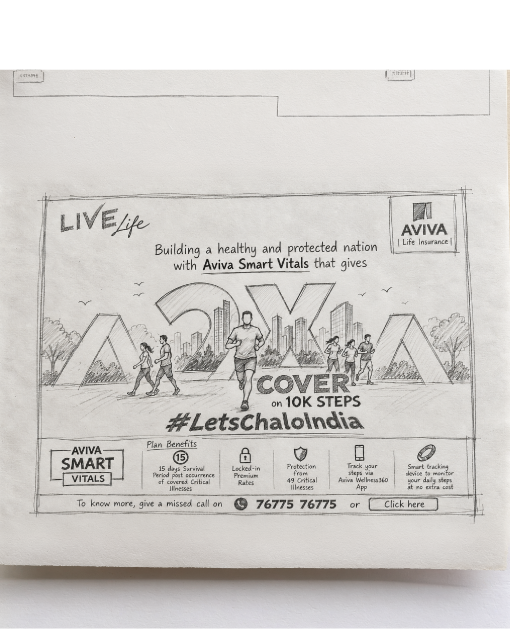
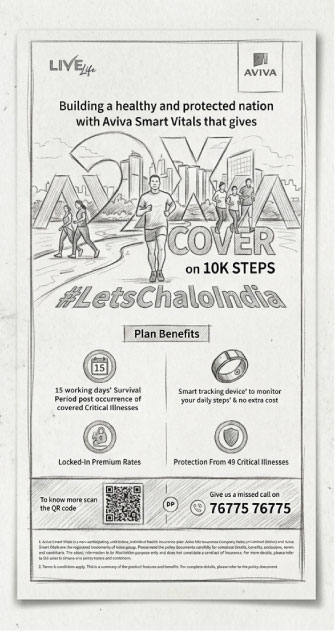
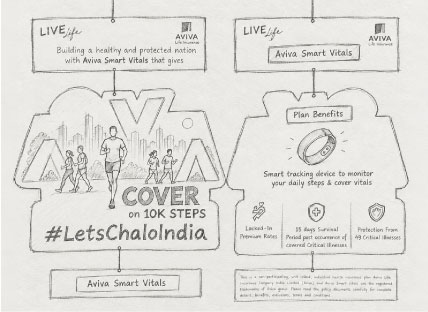
The launch films and key visual connected the step goal, the product benefit and the campaign invitation. The ring and tracker metaphor made the emotional logic clear, while the product communication made the exchange concrete. Walk consistently. Work towards your fitness goal. Build stronger protection.


The third moment was reassurance
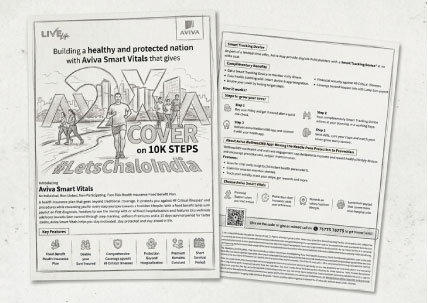
One-pagers, mailers, channel material and customer communication gave people the detail needed to evaluate the proposition. These formats explained how Aviva Smart Vitals worked and helped translate an inspiring campaign into a credible product conversation.


The fourth moment was action
The fifth moment was participation
On-ground activations made movement visible in shared spaces. People could encounter the campaign around colleagues and communities, take part, compare routines and see the national idea become a local experience. This physical layer mattered because it converted an individual health habit into social proof.


The sixth moment continued after purchase
Through wearable technology and the Wellness360 ecosystem, policyholders could track their progress towards enhanced protection. That closed the loop between communication and product experience. The brand did not disappear after the policy was issued. It remained present through a behaviour the customer could see and influence.
An integrated system rather than matching artwork
The campaign ran across social media, performance media, customer communication, business and channel touchpoints, digital kiosks, physical collateral and on-ground activation. The work included a lot of integrated pieces of content across five platforms.
Consistency did not mean repeating the same message everywhere. It meant protecting the same logic everywhere. A teaser created curiosity. A film created emotional understanding. A performance ad made the benefit explicit. A one-pager supplied detail. A standee made the idea visible in a physical environment. An activation turned the message into behaviour.
Every asset answered a different audience need, but all of them returned to the same product truth: healthier living could strengthen life protection.


The measurement
We looked at the campaign across visibility, attention, engagement and participation. This helped separate passive exposure from deeper evidence that the idea had travelled.
| Measure | Result | What it represents |
| Participation | Approximately 19.22 crore | Steps walked collectively towards stronger protection |
| Visibility | 5.96 million | Media impressions delivered |
| Visibility | 1.73 million | People reached |
| Scale | 101 | Content pieces across five platforms |
| Attention | 4.58 million | Video views |
| Attention | 3.15 million | Views on the two launch films |
| Attention | 00:53 | Average view duration for the hero film |
| Engagement | 1,00,112 | Total engagements |
| Engagement | 3.98% | Engagement rate on owned social media |
| Engagement | 14% | Engagement rate on Instagram |

Why the work succeeded
The communication began with a real product advantage. The creative idea did not sit above the proposition as decoration. It explained the proposition in a form people could remember and use.
The behaviour already existed. We did not ask India to adopt an unfamiliar action. We gave a familiar action a larger meaning.
The emotional reward and functional reward supported each other. Better health served the individual. Stronger protection served the family. Neither side felt incidental.
The system respected context. Short-form content created curiosity. Films carried emotion. Detailed material supported evaluation. Activations made participation social. The product ecosystem sustained the relationship.
Measurement followed the journey. We could see whether the campaign had been delivered, watched, engaged with and acted upon.
The larger lesson
Financial services brands often speak about being part of a customer’s life. That claim becomes meaningful only when the product can earn a role in the customer’s routine.
Aviva Smart Vitals did that by connecting a long-term promise with a daily behaviour. The policy protected the future. The step count made the relationship visible today. #LetsChaloIndia gave that personal behaviour a collective identity.
For us at Auraa, this case is a reminder that relevance does not always come from making a louder claim. Sometimes it comes from finding the smallest useful place a brand can occupy in a person’s day, then building the entire communication system around it.
In this case, that place was one step.
Then another.
And eventually, 19.22 crore of them.

India did not just watch the campaign.
India walked it.
Campaign summary
| Business challenge | Make a life insurance proposition relevant before a claim and sustain engagement beyond purchase. |
| Audience truth | People think about living healthier more often than they think about insurance, but both health and protection are expressions of responsibility. |
| Product truth | Consistent achievement of the applicable fitness goals could help eligible customers unlock up to two times the life cover at no additional premium, subject to product terms. |
| Strategic thought | Every step towards better health is a step towards better protection. |
| Creative platform | #LetsChaloIndia |
| Experience design | A connected journey across films, social media, performance advertising, customer and channel communication, digital kiosks, collateral, activation and the Wellness360 ecosystem. |
| Reported outcome | Approximately 19.22 crore steps, 5.96 million impressions, 4.58 million video views and 1,00,112 engagements during January to March 2026. |